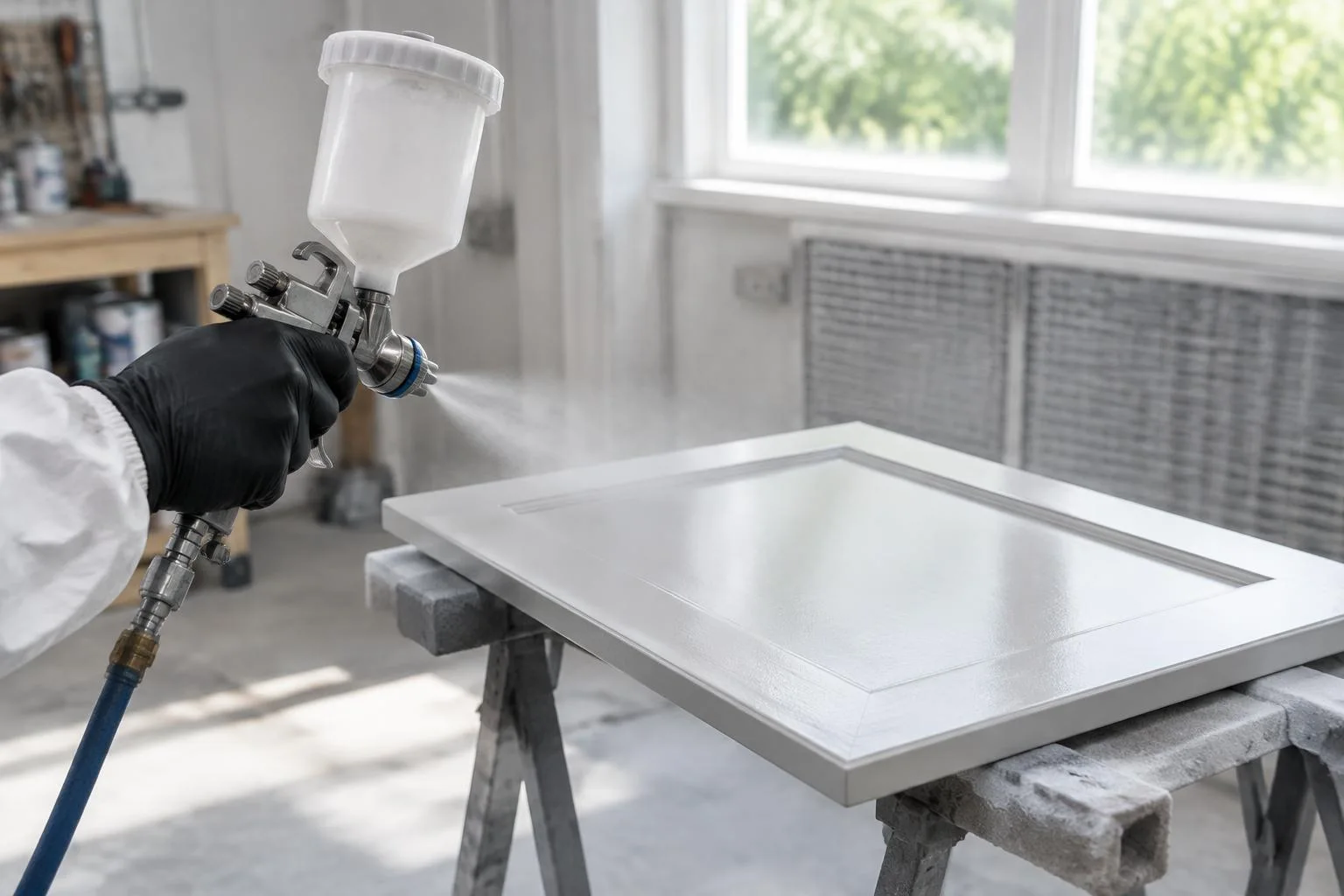
Spraying internal doors with HVLP
HVLP stands for high volume, low pressure. It sprays a soft, controlled mist of paint, which suits doors because it leaves a smooth finish free of brush marks with less overspray than an airless machine. Panelled doors benefit most, as the spray reaches into mouldings evenly where a brush can leave runs in the corners. Flush doors come out with a very clean, even surface.
On the hinges or off
Doors can be sprayed where they hang or taken off. Leaving them on the hinges means masking the frame, floor and surrounding walls carefully and spraying in place, which keeps the house usable. Taking doors off lets us lay them down or hang them in a protected area and coat the faces and edges in one go, then rehang them once dry. Which works better depends on the number of doors, the space available and whether the frames are being painted too.
Hardware and preparation
Handles, latches, hinges where needed, letter plates and finger plates are removed or masked before spraying, and kept safely so they go back where they came from. The doors are washed, sanded and filled where they are dented, with bare areas primed. Old chipped edges are smoothed so the new coat does not show them.
Front doors
Timber front doors are usually brush painted in place, after sanding, repairing any soft or split areas and priming bare wood, using a paint made for outdoor joinery. Composite doors can often be painted too, but they need careful cleaning, keying and a suitable primer, and it is worth checking the door maker’s guidance first. If your front door is uPVC, our uPVC spraying page explains the different approach.
Drying and when the door can close
A door can feel dry to the touch long before it is ready to close. Shut it too soon and the paint can stick to the frame or seals. Internal doors are often left ajar or wedged for a while. For a front door, we start early so it can be closed and locked by evening, and agree with you how it will be kept secure. Weather is checked before booking outside work.
Glazed and panelled doors
Doors with glass panels need the glass masked tightly, and the beading around it painted carefully so the seal is not broken. Panelled doors have mouldings where brushed paint collects in runs and drips, which is why spraying gives them such a clean result. Very old doors may carry many layers of paint in the mouldings, and some may need taking back before spraying so the detail shows again.
Choosing a finish for doors
Satin and eggshell are popular for internal doors because they are easy to wipe and hide small knocks. Gloss gives a traditional look but shows every flaw underneath. Colour matters too: white doors suit most homes, while darker shades on a feature door or a whole hallway are increasingly popular. We can suggest finishes once we see the doors and the rooms around them.
Frames, linings and the rest of the woodwork
A freshly sprayed door can make a tired frame look worse, so most people have the linings and architraves done at the same time. These are usually brushed in place after preparation. If skirting and other woodwork are included, the whole room can be finished together, and our woodwork painting page covers that side in more detail.
Arranging door work
Send a rough count of the doors, whether they are panelled or flush, and whether frames and skirting are included. Photos help. Call Eric on 07872 324935 or use the form on this page.