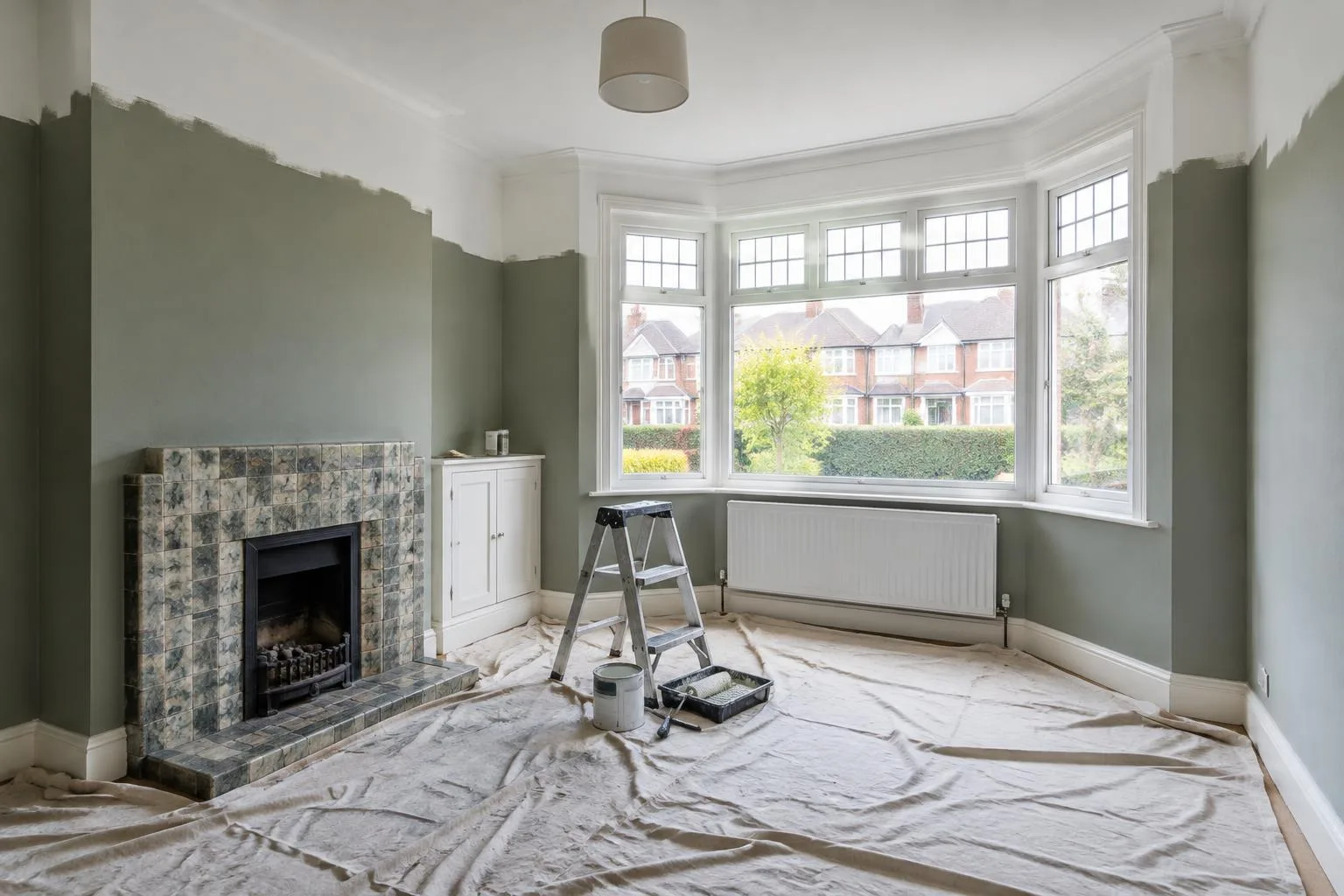
Why there is no single figure
You will find plenty of headline prices online for painting a room, but they rarely match what your room actually needs. A decorator’s quote is built from the time and materials the job takes, and that varies with the room’s size, its condition, what is included and how much preparation it needs. Understanding these factors helps you compare quotes properly and decide what you want done.
Size and ceiling height
The amount of wall and ceiling surface is the starting point. A small box bedroom has far less area than a through lounge, and a room with high ceilings, typical of Victorian and Edwardian houses, adds a lot of extra wall. Taller rooms also need steps, platforms or a tower to reach the top safely, which takes time to set up and move. Stairwells are the extreme case, with tall walls over a drop. Awkward shapes such as alcoves, chimney breasts, sloping loft ceilings and bay windows add cutting in and slow the work down.
Ceilings and woodwork
A quote for “painting a room” can mean very different things. Walls only is the simplest. Adding the ceiling brings more area and slower overhead work. Woodwork, meaning the door, frame, skirting, architraves, window and radiator, is detailed and often takes as long as the walls, especially if it needs sanding and several coats. Always check which surfaces are included, so you are comparing like with like.
Condition and filling
Preparation is where rooms differ most. Walls in good order need little more than a wipe and a light sand. Others need cracks raked out and filled, holes from shelves and pictures repaired, flaking areas scraped back and stains sealed. Old wallpaper may need stripping first. Each step takes time, and some filler needs to dry before it can be sanded and painted. A room that has not been decorated for many years nearly always needs more preparation than one repainted recently.
Colour changes
Going over a similar colour is straightforward. A big change, such as dark red to white, or a pale wall to a deep shade, usually needs extra coats to get even coverage, and sometimes a tinted undercoat. Strong colours can also need more careful cutting in, because any mistakes along the ceiling line are more visible.
Furniture and access
An empty room is quicker to protect and paint than a full one. Furniture can be moved into the middle and covered, but large wardrobes, pianos, beds and fitted units slow things down and leave areas harder to reach. Clearing small items, pictures and curtains before the decorator arrives saves time. If heavy items need moving, agree who is responsible.
The number of coats
Most walls need two coats of emulsion for an even, lasting finish, and new plaster needs a mist coat before that. Woodwork may need an undercoat and a topcoat, or two coats of a modern system. Cheaper paint can mean extra coats to hide the old colour, so the price of the tin is only part of the story.
Paint quality and special products
Trade-quality paints usually cover better and last longer than budget ranges, which can mean fewer coats. Some rooms need special products: stain-blocking primers for water marks or smoke, moisture-resistant paints for bathrooms and kitchens, and hard-wearing finishes for hallways and children’s rooms. These cost more than standard emulsion but solve problems that ordinary paint cannot. A good quote should say which paints are being used.
Comparing quotes fairly
When you have more than one quote, line them up against the same list: which surfaces, what preparation, how many coats, which paints, and who moves the furniture. A lower quote that leaves out the ceiling or the woodwork is not really cheaper. If something is unclear, ask before you book.
Repairs that are not decorating
Sometimes the walls need more than filling, such as loose plaster that needs patching or damp that needs fixing first. These may be separate jobs for a plasterer or other trade, priced on their own.
One room or the whole floor
Painting several rooms at once is usually more efficient than one at a time. Set-up, protection and clearing away happen once, and materials can be bought for the whole job. If you are thinking of decorating more than one room in the coming months, it is worth asking for a quote that covers them together.