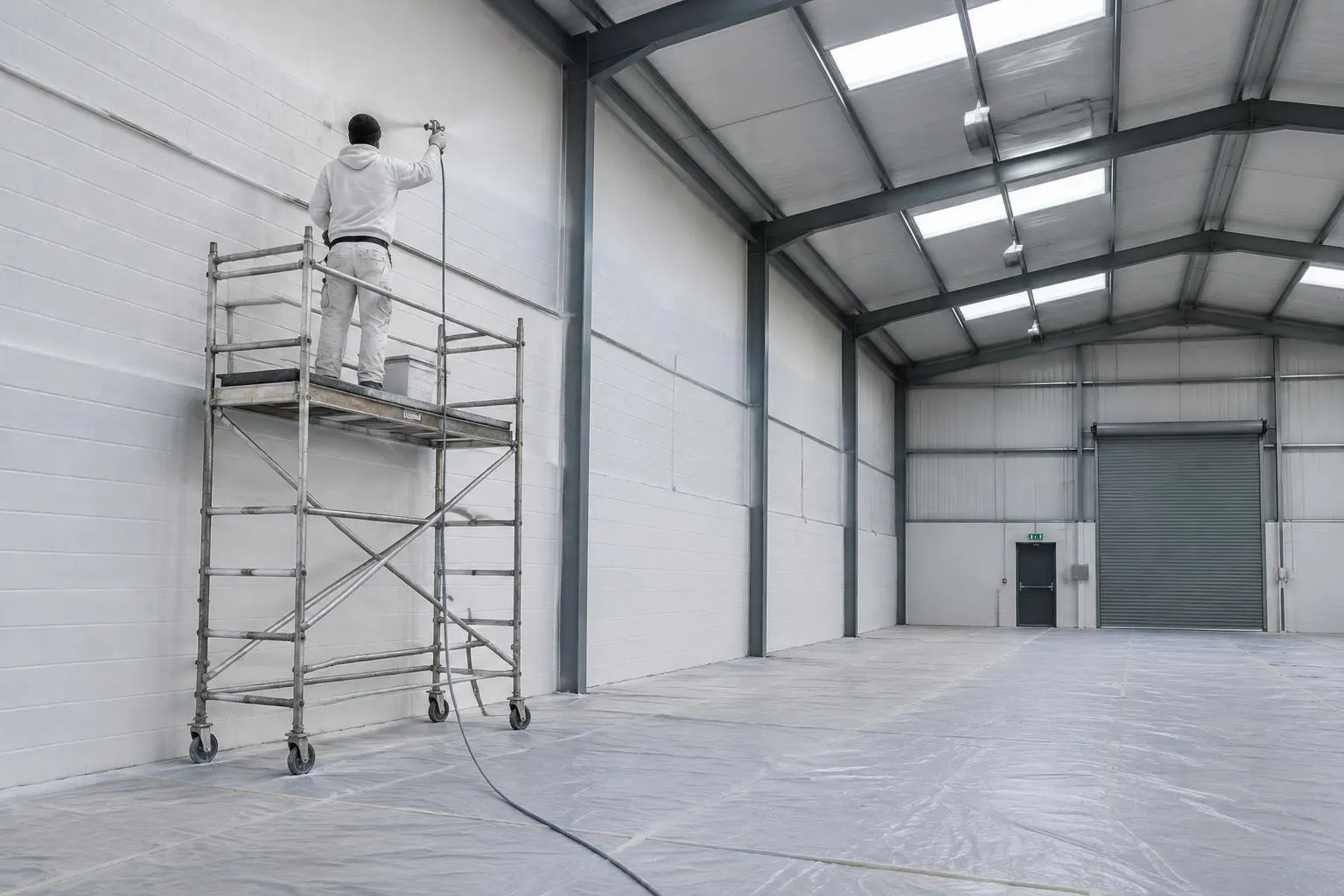
The buildings we paint
Industrial work covers warehouses, distribution and storage buildings, workshops, trade counters, light industrial units and the offices, staff rooms and welfare areas attached to them. Some jobs are a full refresh of an empty unit before a new tenant moves in; others are a repaint of a busy site that cannot stop operating. The approach is quite different, so tell us which one you have.
Large walls and high ceilings by airless spray
The sheer size of industrial walls and ceilings is where airless spraying earns its place. A high-pressure pump delivers paint quickly and evenly across blockwork, plasterboard and lined walls, and high ceilings can be coated from a tower or powered access without the slow back-and-forth of rolling overhead. Spraying needs thorough masking of lights, sensors, doors and anything that must not be coated, so the preparation time is significant, but on big open areas the overall job is usually much quicker.
Steelwork and cladding interiors
Inside many units, the steel portal frames, columns, purlins and the inner face of the cladding are visible. These surfaces need different preparation from walls. Loose rust and flaking coatings are removed, surfaces are cleaned of dust and grease, and a primer suited to the metal goes on before topcoats. Galvanised steel in particular needs a specific primer to get good adhesion. Fire-protective coatings on structural steel are a specialist area, so if your steel has any, tell us and we will work around it rather than over it.
Working around operations
Few sites can close. We plan the work in zones, covering racking and stock, coordinating with forklift routes and loading times, and keeping walkways and fire exits clear. Work can be arranged outside shift hours or at weekends by agreement where the site allows. Drying times and ventilation are built into the plan, especially where staff will return to the area the next morning.
Safety and access
Height is the main hazard on industrial jobs. Access is chosen to suit the building, such as mobile towers or powered access, with the area beneath controlled while we work overhead. If your site requires an induction, permits, method statements or particular safety equipment, let us know at the outset so the plan reflects it.
Floors, lines and the rest of the site
Walls and ceilings are often only part of the picture. Workshop and storage floors can be coated as a separate stage once the overhead work is finished, and our floor painting page explains the preparation involved. Offices and welfare rooms in the same building can be decorated alongside.
Light, colour and visibility
Light colours on walls and ceilings reflect more of the available light, which can make a large unit feel brighter. Many businesses keep the upper walls and ceiling pale and use a darker or tougher band on the lower walls, where pallets, trolleys and forklifts make contact. Doors, bollards, barriers and other features that need to stand out can be finished in contrasting colours. Floor lines and markings are planned separately with the floor coating.
Empty units between tenants
Landlords and agents often want an empty industrial unit refreshed before it is marketed. Without stock or staff, the work is simpler to plan: walls and ceilings can be sprayed in one sequence, steelwork prepared and painted, and offices and toilets brought up to a clean, neutral standard so the unit shows well to the next occupier.
Workshops and trade counters
Smaller units, such as workshops and trade counters, often combine a customer area at the front with storage or workspace behind. The front can be decorated like a shop, with a clean, durable finish, while the back is coated for hard wear. Both can be planned around opening hours.
Getting a quote
Send the address, approximate floor area and ceiling height, photos of the walls and roof steel, and your working hours. Call Eric on 07872 324935 or use the form.